
📍 Renaissance Dental Clinic — 64-66 LGF, Gate No-2, Jaipuria Mall, Ahinsha Khand II, Indirapuram, Ghaziabad 201014 | 📞 0120-4225557
Expert Pediatric Dental Guidance
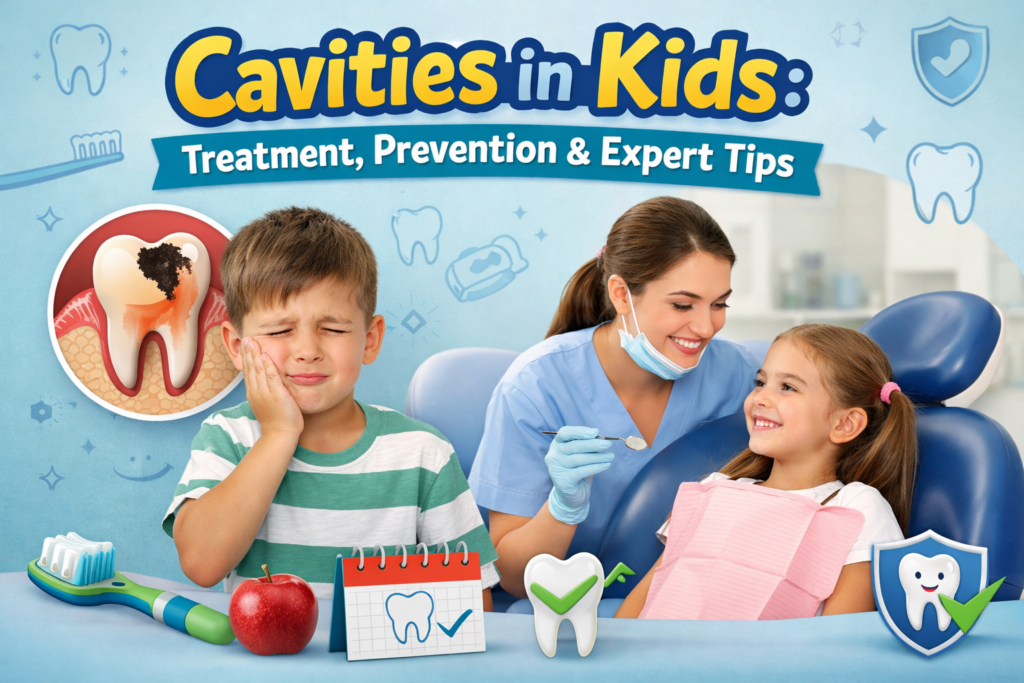
By Dr. Anamika Jain — MDS, Gold Medalist · Renaissance Dental Clinic, Indirapuram | Serving Indirapuram · Vaishali · Vasundhara · Noida · Ghaziabad📅 Book a Free Consultation
📋 What You’ll Learn in This Article
- What Are Cavities in Kids?
- Why Cavities Are Common in Indirapuram & Ghaziabad
- Top Causes of Cavities in Children
- Signs & Symptoms: How to Spot a Cavity
- Stages of Tooth Decay in Kids
- Cavity Treatment Options for Kids
- Prevention: 10 Expert Tips
- Diet & Nutrition Guide for Healthy Teeth
- Why Baby Teeth Cavities Must Not Be Ignored
- FAQs About Cavities in Kids
- Why Choose Dr. Anamika Jain at Indirapuram?
🦷 The Basics
What Are Cavities in Kids?
Cavities — medically known as dental caries — are permanently damaged areas on the hard surface of teeth that develop into tiny holes or openings. In children, cavities are one of the most common chronic diseases, five times more prevalent than asthma. They begin when bacteria in the mouth convert sugars from food and drinks into acids, which then erode tooth enamel over time.
As a child dentist in Indirapuram, Dr. Anamika Jain sees dozens of children every week with various stages of tooth decay — from tiny white spots to fully collapsed baby teeth. The good news? Cavities are 100% preventable when caught and managed early.
💡 Did You Know? In India, studies suggest that over 50–60% of school-age children have at least one untreated cavity. Early intervention at a trusted pediatric dental clinic in Indirapuram can prevent pain, infections, and costly treatments later.
60%
Children in India have untreated cavities
5×
More common than asthma in kids
100%
Preventable with proper care
1 yr
Age for first dental visit (recommended)
📍 Local Context
Why Cavities Are Common in Indirapuram & Ghaziabad NCR
Indirapuram is one of the fastest-growing residential townships in Ghaziabad, bordering Noida and Delhi. With a dense population of families in localities like Ahinsha Khand I & II, Shakti Khand, Nyay Khand, Vaibhav Khand, Niti Khand, and surrounding areas like Vasundhara and Vaishali, the demand for quality child dental care in Indirapuram has never been higher.
Several local lifestyle factors in this region contribute to a higher incidence of childhood cavities:
🛍️
Easy Access to Sugary Snacks
Malls like Jaipuria Mall, shopping centers in Vaishali, and local markets make sugary snacks, colas, and fast food highly accessible to kids.
📱
Screen Time & Late Bedtime Snacking
Increased screen time has led to a rise in late-night snacking without brushing — a leading cause of rapid tooth decay.
🏫
School Canteen Culture
Chips, biscuits, chocolates and packaged juices from school canteens across Indirapuram contribute to daily sugar exposure.
🚰
Fluoride Deficiency
Some areas in Ghaziabad have suboptimal fluoride levels in water supply, making children’s teeth more susceptible to decay.
This is why having a dedicated kids dentist near Jaipuria Mall, Indirapuram makes a real difference. Renaissance Dental Clinic, located at Gate No-2 of Jaipuria Mall, is centrally accessible to families from Ahinsha Khand, Shakti Khand, Vaishali, Vasundhara, Noida Sector 62, and beyond.
📍 Ahinsha Khand I & II📍 Shakti Khand📍 Nyay Khand📍 Vaibhav Khand📍 Niti Khand📍 Vasundhara📍 Vaishali📍 Noida Sector 62📍 Kaushambi📍 Raj Nagar Extension
🔬 Root Causes
Top Causes of Cavities in Children
Understanding what causes cavities helps parents take the right preventive steps. Here are the most common culprits that our pediatric dentist in Indirapuram identifies in young patients:
1. Frequent Sugar & Starch Consumption
Every time your child eats or drinks something sugary — biscuits, chocolates, fruit juices, cold drinks, or even flavoured milk — bacteria in their mouth feast on these sugars and produce acid. The more frequently they snack, the more time teeth spend under acid attack.
2. Poor Brushing Technique or Irregular Brushing
Many children brush too quickly, miss back molars, or don’t brush before bed. Plaque — a sticky film of bacteria — forms on teeth within 24 hours and hardens into tartar if not removed.
3. Bottle & Sippy Cup Misuse (Baby Bottle Tooth Decay)
Putting a baby to sleep with a bottle of milk, formula, or juice is one of the fastest routes to early childhood caries. The liquid pools around the baby’s teeth all night, causing rapid decay — often called “nursing caries” or “bottle rot.”
4. Dry Mouth & Mouth Breathing
Saliva is nature’s cavity fighter. It neutralises acids and washes away food particles. Children who breathe through their mouths (common with allergies or enlarged adenoids) have chronically dry mouths, making them more cavity-prone.
5. Skipping Dental Check-Ups
Many families in Ghaziabad and Indirapuram only visit a dentist when a child is already in pain. By then, cavities are often advanced. Regular visits to a child dentist in Indirapuram every 6 months allow for early detection and minimal intervention.
6. Genetics & Enamel Defects
Some children are born with softer enamel due to genetic factors or complications during pregnancy and early infancy (illness, certain medications). These children need more frequent monitoring.
🔍 Warning Signs
Signs & Symptoms: How to Spot a Cavity in Your Child
Children often don’t complain about tooth pain until a cavity is quite advanced. As a vigilant parent, watch for these signs and visit a kids dentist near you in Indirapuram promptly:
- White, brown, or black spots on teeth (especially on the chewing surfaces or near the gum line)
- Toothache or tooth sensitivity to hot, cold, or sweet foods/drinks
- Pain when biting or chewing
- Visible holes or pits in the teeth
- Bad breath that doesn’t go away with brushing
- Swollen, red, or bleeding gums around a tooth
- Crying or irritability in toddlers around feeding time (signs of baby bottle tooth decay)
- Swelling on the face or jaw (sign of abscess — requires urgent dental visit)
- Your child avoiding certain foods due to pain
- Dark staining that doesn’t wipe off with a cloth
⚠️ Warning: Facial swelling, fever, or a child who refuses to eat due to tooth pain are dental emergencies. Contact Renaissance Dental Clinic’s emergency line at 0120-4225557 immediately.
📊 Progression
Stages of Tooth Decay in Kids (How It Gets Worse)
Tooth decay progresses in distinct stages. Early detection at any stage can dramatically change the outcome and cost of treatment.
⚪
Stage 1: White Spot Lesion
Demineralisation of enamel. Appears as chalky white or opaque areas. Fully reversible with fluoride and diet changes.
🟡
Stage 2: Enamel Decay
Enamel starts breaking down. Tooth discolouration appears. Needs tooth filling to stop progression.
🟠
Stage 3: Dentin Decay
Decay reaches the dentin (softer layer under enamel). Child experiences sensitivity. Requires restoration or filling.
🔴
Stage 4: Pulp Involvement
Decay reaches the nerve (pulp). Severe pain, possible abscess. Pulpotomy or root canal treatment required.
⚫
Stage 5: Abscess / Tooth Loss
Infection spreads. May need extraction and space maintainer to protect permanent tooth alignment.
💊 Treatment
Cavity Treatment Options for Kids at Our Indirapuram Clinic
At Renaissance Dental Clinic in Indirapuram, Dr. Anamika Jain uses the most gentle, child-friendly techniques available. Every treatment plan is tailored to the child’s age, the stage of decay, and the child’s dental anxiety level.
🔵 Fluoride Treatment
For early-stage (white spot) lesions, professional fluoride varnish or gel can remineralise the enamel and reverse the decay. This is quick, painless, and highly effective for children aged 2–6.
🔵 Teeth Filling (Restoration)
The most common treatment for cavities in kids. The decayed portion is gently removed and the tooth is restored with composite (tooth-coloured) or glass ionomer material. Learn more about teeth filling for children at our Indirapuram clinic.
🔵 Dental Crowns for Kids
When a baby tooth is too damaged for a simple filling, a stainless steel or tooth-coloured crown protects the remaining tooth structure and keeps the space for the permanent tooth. Read about dental crowns for children in detail.
🔵 Pulpotomy / Root Canal Treatment for Children
When decay reaches the pulp (nerve) of the baby tooth, a pulpotomy (partial nerve removal) or pulpectomy is performed to save the tooth. This is NOT the same as an adult root canal and is much quicker and gentler. Explore our root canal treatment for children.
🔵 Sedation Dentistry / Laughing Gas
For anxious children or those needing extensive treatment, we offer nitrous oxide (laughing gas) sedation — completely safe, fast-acting, and wears off quickly. This allows treatment to be completed comfortably without any trauma. Learn more about sedation dentistry for kids.
🔵 Tooth Extraction + Space Maintainer
In the most advanced cases, extraction becomes necessary. To prevent neighbouring teeth from drifting and blocking the permanent tooth’s path, a space maintainer device is fitted. This preserves future alignment without needing braces.
🦷 Teeth Filling👑 Dental Crown🏥 Root Canal😊 Laughing Gas📋 Consultation🚨 Dental Emergency
🛡️ Prevention
10 Expert Tips to Prevent Cavities in Kids
Prevention is always better — and cheaper — than cure. Here are Dr. Anamika Jain’s top 10 evidence-based tips for keeping your child’s teeth cavity-free:
- Start brushing early: Wipe your baby’s gums with a damp cloth from birth. Start using a soft-bristle toothbrush as soon as the first tooth appears (around 6 months).
- Use fluoride toothpaste correctly: A rice-grain-sized amount for children under 3, and a pea-sized amount for ages 3–6. Spit, don’t rinse — let fluoride stay on teeth.
- Brush twice daily, always before bed: Nighttime brushing is the most critical — saliva production drops during sleep, removing your child’s natural defence.
- Start flossing when teeth touch: As soon as two teeth are in contact, bacteria can hide between them. Flossing removes what brushing can’t reach.
- Limit sugary drinks: Replace colas, fruit juices, and flavoured milk with plain water as the primary drink. If juice is given, dilute it and serve with a meal only.
- Never put your baby to sleep with a bottle: If they need something, offer only plain water. Avoid sippy cups with sugary drinks between meals.
- Choose teeth-friendly snacks: Raw vegetables, cheese, nuts, and fresh fruits are excellent. Avoid sticky sweets, toffees, and sour candies.
- Ask about sealants: Dental sealants are thin protective coatings applied to the chewing surfaces of back molars. They prevent cavity formation in the grooves of teeth by up to 80%.
- Get regular professional fluoride treatments: At every 6-month visit to your child dentist in Indirapuram, ask about fluoride varnish application.
- Schedule regular dental check-ups: Every 6 months starting at age 1. Early detection means less pain, less cost, and better outcomes for your child.
🥗 Nutrition
Diet & Nutrition Guide for Healthy Teeth in Kids
What your child eats has a direct impact on their dental health. Here’s a simple guide to the best and worst foods for their teeth:
✅
Cavity-Fighting Foods
Cheese, yoghurt, milk, raw carrots, apples, celery, almonds, leafy greens, eggs, fish. These neutralise acids or stimulate saliva.
❌
Cavity-Causing Foods
Sugary biscuits, colas, packaged fruit juices, sticky sweets, sour candies, chips, white bread, chocolates, and sports drinks.
⚠️
Eat in Moderation
Dried fruits (raisins, dates), honey, bananas, citrus fruits — nutritious but high in natural sugars that can cling to teeth.
💧
Best Drink: Water
Plain water (especially fluoridated) is the #1 drink for dental health. It rinses away food, neutralises acids, and keeps the mouth hydrated.
💡 Dr. Anamika’s Tip: It’s not just what your child eats — it’s how often. Constant snacking throughout the day keeps teeth in a continuous acid environment. Aim for 3 meals and maximum 2 snack times, followed by water to rinse the mouth.
🍼 Baby Teeth
Why Baby Teeth Cavities Must NEVER Be Ignored
A very common misconception among parents in Indirapuram and across India is: “It’s just a baby tooth — it will fall out anyway, so why treat it?”
This thinking can cause serious, long-term harm. Here’s why baby teeth matter far more than most people realise:
- Space holding: Baby teeth act as natural space maintainers for permanent teeth. If a baby tooth is lost early due to cavity, neighbouring teeth drift into the gap, causing crooked permanent teeth and the need for braces.
- Speech development: Front baby teeth are essential for pronouncing sounds like “f”, “v”, “th”, and “s”. Early loss can cause speech delays.
- Nutrition: A child with tooth pain avoids eating properly, leading to nutritional deficiencies during critical growth years.
- Infection risk: An untreated cavity in a baby tooth can progress to an abscess that infects the underlying permanent tooth bud — potentially damaging or discolouring the adult tooth before it even erupts.
- Confidence: Children with badly decayed front teeth face social issues, self-consciousness, and school problems.
- Pain: Untreated cavities cause significant, unnecessary pain that affects sleep, concentration, and mood.
If your child has a cavity in a baby tooth, visit our child dental clinic in Indirapuram right away. Dr. Anamika Jain will recommend the most conservative, appropriate treatment to save the tooth — whether a filling, crown, or pulpotomy.
❓ FAQs
Frequently Asked Questions About Cavities in Kids
At what age should my child first visit a dentist?
The Indian Dental Association and American Academy of Pediatric Dentistry both recommend the first dental visit by age 1, or within 6 months of the first tooth erupting — whichever comes first. At Renaissance Dental Clinic, Indirapuram, we offer a friendly first-visit experience designed to make babies and toddlers feel comfortable.
Can a cavity heal on its own without treatment?
In its very earliest stage (white spot lesion), enamel demineralisation can be reversed with fluoride and dietary changes. However, once a visible cavity or hole forms, it will not heal on its own and requires professional treatment. The longer it is left untreated, the deeper and more expensive the treatment becomes.
Is dental treatment painful for kids?
At our pediatric dental clinic in Indirapuram, we use the latest gentle techniques, including local anaesthesia and laughing gas (nitrous oxide sedation), to ensure your child feels no pain. Dr. Anamika Jain is specially trained in child behaviour management techniques to keep kids relaxed and comfortable throughout treatment.
How often should my child visit the dentist?
Every 6 months is the standard recommendation for a healthy child. Children with a history of cavities, braces, or special needs may need more frequent visits — typically every 3 to 4 months. Our pediatric prevention programme helps customise the right schedule for your child.
What is the cost of cavity treatment for kids in Indirapuram?
Treatment costs vary based on the number of teeth affected and the type of treatment needed. Simple fillings are very affordable. We believe every child deserves quality dental care and offer transparent, ethical pricing. Call us at 0120-4225557 or book a consultation to discuss a personalised treatment plan.
What toothpaste should my child use?
Use a fluoride toothpaste. For children under 2, a smear (rice-grain size) is sufficient. Ages 3–6: pea-sized amount. Ages 6 and above: standard amount. Make sure children spit out the toothpaste and don’t swallow it. Avoid toothpastes with high abrasives or whitening agents for young children.
My child is scared of the dentist. What can I do?
Dental anxiety is very common in children. Our clinic is designed specifically to be warm, colourful, and non-threatening. We use behaviour management techniques, show-tell-do methods, and offer nitrous oxide (laughing gas) for anxious children. Reading books about dentists and role-playing at home also helps prepare children for their visit.
⭐ Why Choose Us
Why Choose Dr. Anamika Jain at Renaissance Dental Clinic, Indirapuram?
If you are searching for a “child dentist near me in Ghaziabad” or “best pediatric dentist in Indirapuram”, here’s why hundreds of families from Ahinsha Khand, Shakti Khand, Vaishali, Vasundhara and Noida trust us:
🏅
Gold Medalist Specialist
Dr. Anamika Jain is a post-graduate from King George’s Medical University (KGMC), Lucknow — one of India’s most prestigious institutions.
👶
100% Child-Focused
Our clinic is a certified child dental centre, designed exclusively for the needs of children from infants to teenagers.
📍
Prime Location
Located at Gate No-2, Jaipuria Mall, Ahinsha Khand II — easily accessible from all areas of Indirapuram, Vaishali, and Vasundhara.
🕐
Convenient Hours
Open Mon–Sat, 10 AM–8 PM. Sunday appointments available. Flexible scheduling for busy school-going kids.
😌
Pain-Free Approach
We use laughing gas, gentle anaesthesia, and proven behaviour management techniques to ensure every child’s comfort.
🔬
Full Spectrum of Services
From fillings and crowns to braces, aligners, root canals, sedation and dental emergencies — all under one roof.
👩⚕️
Dr. Anamika Jain — MDS (Pediatric Dentistry), Gold Medalist
Post-Graduate from King George’s Medical University (KGMC), Lucknow. Former clinician at Ram Manohar Lohia Hospital, New Delhi. Founder & Lead Pediatric Dentist at Renaissance Dental Clinic, Indirapuram. Serving children across Indirapuram, Vaishali, Vasundhara, Noida & Ghaziabad for over a decade.
📞 0120-4225557 | 🌐 childdentistindirapuram.com
Give Your Child a Cavity-Free Smile ✨
Visit Renaissance Dental Clinic at Jaipuria Mall, Indirapuram. Trusted by thousands of families in Ghaziabad, Vaishali, Vasundhara, and Noida NCR.
📅 Book an Appointment📞 Call 0120-4225557💬 WhatsApp Us
📍 64-66 LGF, Gate No-2, Jaipuria Mall, Ahinsha Khand II, Indirapuram, Ghaziabad 201014