
CHILD DENTIST INDIRAPURAM
Renaissance Dental Clinic — Certified Child Dental Centre
Expert Paediatric Dentist: Dr. Anamika Jain (Gold Medalist, KGMU Lucknow)
www.childdentistindirapuram.com | Ph: 0120-4225557 | WhatsApp: +91 84700 77778
Email: info@renaissanceclinicindia.com
64-66 LGF, Gate No. 2, Jaipuria Mall, Ahinsa Khand II, Indirapuram, Ghaziabad, U.P. 201014
PAEDIATRIC DENTISTRY BLOG | CHILD DENTAL ANXIETY GUIDE
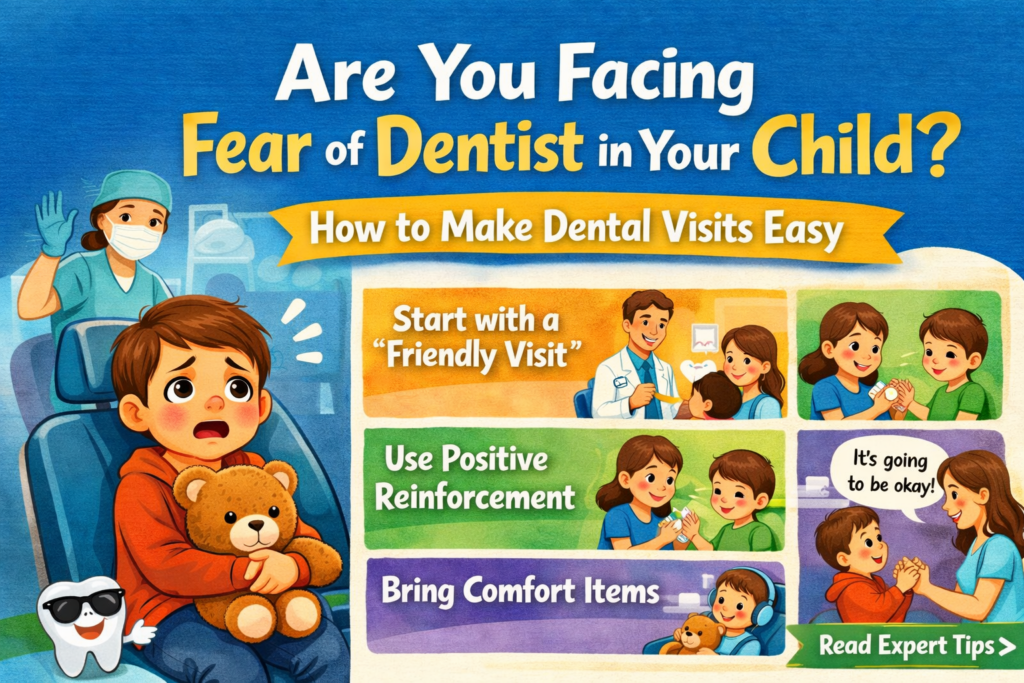
Are You Facing Fear of Dentist in Your Child?
How to Make Dental Visits Easy
Published by Child Dentist Indirapuram | April 2026 | Dr. Anamika Jain, Paediatric Dental Specialist
Does your child burst into tears the moment you mention a dentist? Do they cling to you, refuse to open their mouth, or have a full meltdown just walking into the clinic? If so, you are among millions of parents across India who face this very real, very common challenge every day.
Dental anxiety in children is not simply “being naughty” or “being dramatic.” It is a genuine psychological response — rooted in fear of the unknown, past experiences, sensory sensitivities, or stories heard from friends and family. Left unaddressed, this fear can have long-lasting consequences: skipped dental visits, untreated cavities, infections, speech problems, and a lifelong mistrust of dental care.
The great news? Dental fear in children is completely manageable — and with the right approach, most children can learn to not just tolerate dental visits, but actually look forward to them.
At Child Dentist Indirapuram — Renaissance Dental Clinic — our specialist paediatric dentist Dr. Anamika Jain (Gold Medalist, KGMU Lucknow) has helped hundreds of anxious children in Indirapuram, Vaishali, Vasundhara, Ghaziabad, Noida, and Delhi NCR have safe, comfortable, and even enjoyable dental experiences. In this comprehensive guide, we cover everything parents need to know.
Understanding Dental Fear in Children — What Is Dental Phobia?
Dental phobia — also called odontophobia or dental anxiety — refers to an intense, persistent fear of dental treatment that goes beyond normal nervousness. Studies suggest that between 6% and 20% of children worldwide experience significant dental anxiety that interferes with their ability to receive care.
It is important for parents to understand that this fear is real and valid. The sights, sounds, smells, and sensations of a dental clinic can feel overwhelming to a young child who does not understand what is happening or why. When children feel a loss of control — confined in a dental chair with unfamiliar people leaning over them — anxiety is a completely natural response.
Dental anxiety exists on a spectrum:
| Anxiety Level | Description & Management Approach |
| Mild Nervousness | Child is slightly apprehensive but cooperates with reassurance. Easily managed with gentle communication and positive language. |
| Moderate Anxiety | Child resists, cries, or becomes uncooperative. Requires behaviour management techniques, distraction, and possibly nitrous oxide sedation. |
| Severe Phobia | Child cannot cooperate at all. Requires specialised sedation dentistry or gradual desensitisation over multiple low-pressure visits. |
Identifying where your child falls on this spectrum helps our team plan the most effective and compassionate approach for their individual needs. Call us at 0120-4225557 to discuss your child’s specific situation before booking.
Why Do Children Fear the Dentist? The 7 Root Causes
Understanding why your child is afraid is the first step toward helping them overcome it. Here are the most common root causes of dental anxiety in children:
1. Fear of Pain — The Number One Cause
Pain is the most frequently cited reason for dental anxiety in children and adults alike. A past experience of pain — even a relatively minor one — can leave a lasting memory that makes children dread future visits. Well-meaning warnings from parents or siblings (“it might hurt a little”) can unintentionally reinforce this fear even before any negative experience has occurred.
2. Fear of the Unknown — First-Time Visitors
Children who have never visited a dentist — or who visit very infrequently — are often afraid simply because they do not know what to expect. The unfamiliar environment, instruments, smells (antiseptics, dental materials), sounds (the drill, suction), and sensations (gloved hands in their mouth) can all feel deeply threatening to a young child’s sense of safety.
3. Loss of Control
Children, especially toddlers and young school-age children, have a strong need for autonomy and control. Being asked to lie back in a chair, open wide, and stay completely still while a stranger does things inside their mouth is the complete opposite of feeling in control — and this naturally triggers intense resistance and anxiety.
4. Parental Dental Anxiety — It Is Contagious
Research consistently shows that children of anxious parents are significantly more likely to be dental-anxious themselves. Children are extraordinarily perceptive. Even if you say nothing negative about the dentist, your body language, tone of voice, or an involuntary grimace communicates fear very effectively. Parents need to examine and manage their own dental anxiety to protect their children from absorbing it.
5. Negative Stories from Friends, Family, or Media
School-age children talk. If a friend tells your child that the dentist “pulled out my tooth and it hurt SO much,” that story can implant a powerful fear even without any personal experience. Similarly, exaggerated or scary portrayals of dentists in cartoons, movies, and TV shows contribute to a cultural fear of dental visits that is entirely disproportionate to reality.
6. Sensory Sensitivities
Some children — particularly those with autism spectrum disorder (ASD), ADHD, or sensory processing differences — have heightened sensitivity to touch, taste, sound, or smell. The strong clinical smells, bright overhead lights, vibrations of instruments, and physical contact inside the mouth can be genuinely overwhelming for these children, requiring specially adapted, highly individualised approaches.
7. Traumatic Past Dental Experience
If a child has had a painful, frightening, or poorly managed dental procedure in the past — especially if they felt they were not listened to or were handled roughly — this can create a lasting traumatic memory that significantly amplifies fear of future visits. This is why the quality and compassion of your child’s first dental experiences are so critically important.
| 💡 Key Insight for Parents: The very first dental visit sets the tone for a lifetime of dental attitudes. Research shows that children who have positive first dental experiences are far more likely to maintain regular dental care throughout their lives. This is exactly why choosing a specialist paediatric dentist — not a general dentist — matters so profoundly. |
Warning Signs: How to Know If Your Child Has Dental Anxiety
Children may not always be able to articulate their fear in words. Watch carefully for these common signs that your child may be experiencing dental anxiety:
- Crying, tantrums, or emotional meltdowns when a dental visit is mentioned or approaching
- Complaining of stomachaches, headaches, or feeling unwell on the morning of the appointment
- Refusing to eat or sleep well in the days leading up to the visit
- Asking anxious repetitive questions: “will it hurt?”, “what will they do?”, “do I really have to go?”
- Clinging to parents or refusing to separate in the waiting room
- Gagging or nausea driven purely by anxiety rather than the procedure itself
- Sweating, trembling, or rapid breathing when seated in the dental chair
- Completely shutting down or becoming non-communicative at the clinic
- Physically resisting — pulling away, biting, or scratching
- Crying themselves to sleep the night before a scheduled appointment
| ⚠️ Important Message to Parents: Never dismiss your child’s dental fear as “making a fuss” or “being silly.” Dismissing their fear damages trust and makes the anxiety significantly worse over time. Instead, acknowledge their feelings warmly: “I understand you feel worried. That is completely okay. I am going to be with you the whole time and keep you safe.” |
Consequences of Untreated Dental Anxiety — Why It Cannot Be Ignored
Many parents postpone dental visits indefinitely because their child is too distressed to cooperate. While understandable, this avoidance creates a dangerous cycle with serious long-term consequences for the child’s health and wellbeing:
- Untreated tooth decay spreads rapidly in baby (milk) teeth, leading to pain, infection, and abscesses
- Severely decayed milk teeth may require extraction, affecting speech development and spacing of permanent teeth
- Dental infections can spread beyond the mouth and affect the child’s general health and wellbeing
- Misaligned teeth not treated early with braces or interceptive orthodontics become harder and more expensive to correct later in life
- The dental phobia deepens and worsens with every missed visit, making treatment progressively harder over time
- Children carry unresolved dental anxiety into adulthood, resulting in lifelong poor oral health
- Chronic dental pain affects concentration, school performance, appetite, and quality of life
- Tooth loss from infection impacts the child’s self-esteem, social confidence, and speech
The most compassionate thing a parent can do for a dental-anxious child is to address both the fear and the dental problem simultaneously — with professional support from a specialist paediatric dental team that truly understands children’s psychology, like ours at Child Dentist Indirapuram.
What Parents Can Do at Home: Practical Tips to Prepare Your Child
Long before the appointment, parents play the most important role in shaping how their child feels about going to the dentist. Here are expert-recommended strategies backed by child psychology research:
Start Dental Visits Early — Before Problems Arise
The Indian Dental Association and international paediatric dental organisations recommend that a child’s first dental visit should occur by their first birthday, or within 6 months of the first tooth appearing. Early visits establish the dental clinic as a familiar, friendly place — not a scary one. The earlier you start, the easier dental care becomes for life.
Use Positive, Child-Friendly Language
The specific words you choose to talk about the dentist are incredibly powerful in shaping your child’s expectations and feelings:
| ❌ Avoid These Phrases | ✅ Use These Instead |
| “It won’t hurt, I promise” | “The dentist will count and check your teeth to keep them healthy” |
| “Be brave, it’s just a little pain” | “The dentist is very gentle and will tell you everything first” |
| “Don’t be a baby, just open your mouth” | “You can hold my hand the whole time — I am right here” |
| “If you don’t brush, the dentist will pull your teeth out!” | “The dentist helps us keep our teeth strong and shiny” |
| “Don’t cry, it’s nothing” | “You can raise your hand anytime and the dentist will stop” |
Play Dentist at Home — Make It Familiar
Role-playing dental visits at home is one of the most effective evidence-based strategies to demystify the experience. Let your child be the dentist first — they examine your teeth with a spoon or toy. Then swap roles. Use a soft toothbrush to gently count their teeth. Make it playful, silly, and joyful. When a child knows what to expect, fear dissolves naturally.
Read Books and Watch Child-Friendly Dental Videos
There are many wonderful children’s books and age-appropriate videos featuring beloved characters who visit the dentist happily and confidently. Books featuring familiar characters going to the dentist, or Peppa Pig’s dental episode, can help young children build a positive, normalised mental image of what a dental visit looks and feels like.
Never Use the Dentist as a Threat or Punishment
“If you don’t brush your teeth, the dentist will drill them all!” is perhaps the single most damaging thing a parent can say about dental care. Using the dentist as a threat permanently frames dental treatment as a punishment — making fear and resistance absolutely inevitable. The dentist must always be presented as a kind, caring health helper, just like a doctor or a teacher.
Choose the Right Appointment Time
Book appointments at a time when your child is typically well-rested and in a calm, good mood — mid-morning usually works best for young children. Avoid scheduling dental visits immediately after school, during naptime, or late in the evening when children are tired, hungry, or emotionally depleted and least able to manage stress.
Manage Your Own Anxiety First
Your child takes emotional cues from you constantly. If you are anxious, rushed, or tense on the way to the clinic, your child will absorb that emotional energy. If you have your own dental anxiety, work on managing it privately. On the day of the appointment: breathe deeply, speak slowly and calmly, and project quiet confidence that everything is completely fine.
Bring a Comfort Item
Allow your child to bring a favourite toy, stuffed animal, or small blanket to the appointment. Having a familiar comfort object provides a sense of security and home in an unfamiliar environment. Many of our young patients bring their favourite soft toy and find it helps enormously.
Plan a Fun Post-Appointment Treat
Having something genuinely exciting to look forward to after the dental visit makes a remarkable difference. Tell your child the plan: “After the dentist, we are going to the park / having your favourite dinner / watching your favourite movie.” This shifts their focus from dread to anticipation and creates a positive emotional association with the dental visit.
| ⭐ Expert Parent Tip: Prepare your child the night BEFORE the appointment — not on the morning of the appointment when anxiety is highest. Say: “Tomorrow we visit Dr. Anamika who is really kind. She will use a special tiny mirror to count your teeth and make sure your smile stays beautiful. You can hold my hand the whole time.” Predictability and preparation dramatically reduce anxiety. |
How Our Team Makes Every Visit Easy — Our Child-First Approach
At Child Dentist Indirapuram — Renaissance Dental Clinic — our entire practice is built around one core philosophy: every child deserves to feel completely safe, heard, and respected at the dentist. Here is exactly how we make that a reality for every child who walks through our doors:
Warm, Child-Friendly Clinic Environment
Our clinic at Jaipuria Mall, Indirapuram is thoughtfully designed to feel welcoming and non-threatening to children. The environment is warm, colourful, and friendly — a far cry from the cold, clinical atmosphere that triggers fear in anxious children. From the moment your child arrives, every element is designed to make them feel at ease, curious, and comfortable.
Tell-Show-Do Technique — The International Gold Standard
Dr. Anamika Jain and our entire team consistently use the Tell-Show-Do (TSD) technique, which is internationally recognised as the gold standard in paediatric dental behaviour management:
- TELL — We explain exactly what we are going to do in simple, child-friendly language before touching anything. “I am going to use this little mirror to count your teeth — just like counting stars in the sky!”
- SHOW — We demonstrate every instrument or procedure outside the mouth first, letting the child see, touch, and feel what it is like. No surprises — ever.
- DO — Only after the child has fully seen and understood do we gently perform the procedure, at the child’s own pace, with constant warm, positive communication throughout.
Voice Control and Enthusiastic Positive Reinforcement
Our team is specially trained in paediatric communication techniques. We use calm, warm, enthusiastic voices throughout every appointment. We celebrate every single act of bravery specifically: “You opened SO wide — what a superstar!” — building confidence, self-esteem, and positive associations with dental care that last for years.
Evidence-Based Distraction Techniques
During treatment, we use a variety of proven distraction techniques to redirect the child’s attention away from the procedure and toward something genuinely engaging — storytelling, counting games, conversation about their favourite TV show, ceiling stickers, music. When a child is truly distracted, dental procedures become dramatically easier for everyone involved.
Parents Are Always Welcome
At Child Dentist Indirapuram, parents are always warmly welcomed to stay with their child throughout the appointment. For very anxious or young children, having a parent holding their hand and providing quiet reassurance makes a transformative difference. We treat parents as essential partners in care, not as people to be left in the waiting room.
Nitrous Oxide (Laughing Gas) — The Gentle Anxiety Solution
For children with moderate to significant dental anxiety, we offer Sedation Dentistry with Nitrous Oxide (Laughing Gas). Nitrous oxide is a safe, mild sedative gas inhaled through a comfortable small nose mask. It produces a warm, relaxed, gently euphoric feeling — children often describe it as feeling happy, floaty, and peaceful.
Key benefits of nitrous oxide for dental-anxious children:
- Takes effect within just 3–5 minutes and wears off completely within minutes of stopping the gas
- No injections required at all — simply breathed in through a soft nose mask
- No lasting drowsiness — children can return to school the very same day
- Significantly reduces the perception of pain and procedural discomfort
- Completely safe for children when administered by a trained specialist dentist
- Can be used comfortably for check-ups, fillings, extractions, and most other procedures
Conscious Sedation and General Anaesthesia for Severe Cases
For children with severe dental phobia who genuinely cannot cooperate even with behaviour management and nitrous oxide — including children with special needs, very young toddlers, or those requiring extensive treatment across multiple teeth — we offer conscious oral sedation and general anaesthesia (GA) options. These are provided by trained specialists in a fully equipped, safe medical setting, ensuring all necessary dental treatment can be completed without causing any psychological trauma to the child.
Gradual Desensitisation Programme
For children with significant anxiety who are not in immediate dental pain, we offer a carefully structured gradual desensitisation programme. This involves a series of very short, intentionally non-threatening appointments designed purely to build trust and familiarity with the clinic environment. In the earliest visits, there is no treatment at all — the child simply sits in the chair, meets the team, explores instruments with their hands, and leaves proudly with a sticker and enthusiastic praise. Over several sessions, they gradually become comfortable enough to accept actual treatment without distress.
Our Complete Paediatric Dental Services — Everything Under One Roof
Child Dentist Indirapuram offers a comprehensive range of paediatric dental services, all delivered with our signature gentle, child-first, anxiety-aware approach:
Teeth Filling (Restoration) for Children
- Teeth Filling & Restoration for Children — Baby (milk) teeth are vitally important for chewing, speech, and holding space for permanent teeth. Cavities in milk teeth are treated with tooth-coloured fillings that look natural and completely preserve the tooth’s function. Our gentle approach ensures that even filling appointments are relaxed and stress-free for most children.
Root Canal Treatment for Children (Pulpectomy)
- Root Canal Treatment for Children — When decay reaches the inner pulp of a baby tooth causing severe pain or infection, a pulpectomy (the child-appropriate version of a root canal) saves the tooth and eliminates infection. We perform this procedure with appropriate local anaesthesia and gentle technique so children experience minimal discomfort and can leave feeling comfortable.
Braces for Kids
- Braces for Kids — Crowded, misaligned, or forward-placed teeth are extremely common in children. Early orthodontic treatment during the growth phase corrects these issues more efficiently and prevents far more complex and expensive problems in adulthood. We offer child-friendly braces options with warm, supportive, encouraging follow-up appointments.
Aligners / Invisalign for Children and Teens
- Aligners / Invisalign — For older children and teenagers who are self-conscious about the appearance of metal braces, clear, removable Invisalign aligners offer a virtually invisible way to achieve a beautifully straight smile. Comfortable, easy to clean, and completely removable for eating — perfect for image-conscious teenagers.
Paediatric Dental Consultation and Prevention Programme
- Paediatric Dental Consultation & Prevention — Our comprehensive prevention programme includes professional cleaning, fluoride application, pit and fissure sealants for back teeth, dietary counselling, and thorough oral hygiene education for both children and parents. Prevention is always dramatically better — and far less expensive — than treatment.
Dental Crown for Children
- Dental Crown for Children — For severely decayed or damaged baby teeth, stainless steel crowns or natural-looking zirconia crowns provide durable, long-lasting protection. They restore the tooth’s complete shape, function, and appearance while preventing further breakdown and eliminating pain.
Dental Emergency Services
- Dental Emergency — Accidents happen without warning. A knocked-out tooth from a fall, a chipped tooth, severe toothache, or a swollen face are all dental emergencies that need immediate care. Our team is experienced in managing paediatric dental emergencies compassionately and quickly. Call us immediately at 0120-4225557 or WhatsApp +91 84700 77778 for urgent guidance and priority appointments.
Sedation Dentistry — Laughing Gas / Happy Gas / General Anaesthesia
- Sedation Dentistry for Children — For very anxious children, very young toddlers, and children with special needs, our safe, clinically supervised sedation options ensure that necessary dental treatment can be completed comfortably, safely, and without causing any lasting psychological distress.
Meet Dr. Anamika Jain — Your Child’s Trusted Dental Friend
Dr. Anamika Jain is not just a dentist — she is a specialist who has dedicated her professional career to making children feel genuinely safe, comfortable, and cared for in the dental chair.
- Gold Medalist, Postgraduate Dental Degree — King George’s Medical University (KGMU), Lucknow — one of India’s most prestigious dental institutions
- Extensive clinical experience at Ram Manohar Lohia (RML) Hospital, New Delhi — a premier government teaching hospital
- Specialist in paediatric dental behaviour management — trained in TSD technique, nitrous oxide sedation, and child-centred psychology approaches
- Warm, patient, nurturing communication style — children genuinely relax and feel safe with her from the very first visit
- Comprehensive expertise across full-range paediatric dentistry, smile design, implants, and complete oral care for all ages
- Serving children across Indirapuram, Vaishali, Vasundhara, Ghaziabad, Noida, and the wider Delhi NCR region
Renaissance Dental Clinic proudly holds certification as a Certified Child Dental Centre — meeting the highest standards for safe, ethical, quality paediatric dental care.
Age-by-Age Dental Guide: Milestones and What to Expect
Every developmental stage brings different dental needs and different sources of anxiety. Here is your complete guide to what is normal at each age and how to approach dental care effectively:
| Age | Key Dental Focus | Managing Anxiety at This Stage |
| 0–12 months | First tooth erupts. First dental visit by age 1. Oral hygiene education for parents. | No anxiety yet — purely familiarisation. Parents model calm, positive behaviour at the clinic. |
| 1–3 years | All 20 baby teeth erupt. Cavity risk begins with diet and bottles. | Fear of strangers is developmentally normal. Short visits, lap examinations with parent holding child work best. |
| 3–6 years | Dental check-ups, prevention, first fillings if needed. | Most common and peak age for dental anxiety. TSD technique, distraction, and consistently positive language are essential. |
| 6–9 years | First permanent teeth erupt. Space management critical. | Children can now understand simple explanations. Involving them in small decisions gives them a sense of control. |
| 9–12 years | Full orthodontic assessment. Sealants for permanent molars. | Peer influence becomes very important. Reassure about appearance and normalise having braces as very common. |
| 12+ years | Full orthodontic treatment if indicated. Wisdom teeth monitoring begins. | Teenage autonomy matters deeply. Respect their privacy, involve them directly in treatment planning as partners. |
Special Needs Children — A Tailored, Compassionate Approach
Children with autism spectrum disorder (ASD), ADHD, sensory processing disorder, Down syndrome, cerebral palsy, or other developmental conditions may require additional, carefully tailored adaptations to make dental visits possible and genuinely comfortable. Dr. Anamika Jain has significant experience working with children across a wide range of special needs. Our approach includes:
- Pre-visit desensitisation appointments: Simply visiting the clinic before the treatment appointment to explore the environment, meet the team, and build familiarity with no pressure at all
- Social stories: Customised visual step-by-step stories that walk the child through each moment of the dental visit using clear pictures and simple language
- Sensory accommodations: Dimmed lighting, quieter instruments where possible, unscented products, and weighted blankets if the child finds them calming
- Extended appointment slots: Extra time allocated so there is absolutely no rushing and the child can set their own comfortable pace
- Nitrous oxide or conscious sedation for children who genuinely cannot tolerate procedures while fully awake
- Flexible positioning: Allowing the child to be examined sitting upright or in a parent’s lap if the dental chair is too distressing
- Pre-appointment communication: We encourage parents to call us ahead of time to discuss their child’s specific triggers, communication style, and any helpful strategies
Please always inform us of your child’s specific needs and sensitivities when making your booking so we can prepare the optimal, fully personalised environment and approach before your child even arrives.
10 Quick Tips to Make Dental Day a Happy Day
- Schedule morning appointments when your child is naturally freshest and most energetic — mid-morning is ideal for most children
- Have a calm, enjoyable morning routine on appointment day — no rushing, no stress, no repeated reminders about the dentist
- Let them bring their favourite small toy, stuffed animal, or comfort item to hold during the appointment
- Allow them to wear their favourite outfit to the clinic — feeling good in their clothes genuinely boosts a child’s confidence and cooperative spirit
- Avoid discussing the appointment anxiously or repeatedly in the days beforehand — one brief, positive mention the evening before is ideal
- Arrive 5–10 minutes early so your child can settle into the environment gradually and at their own pace rather than rushing straight into the chair
- Let them explore the waiting area and say hello to the clinic staff before going into the treatment room — familiarity first
- Remain visibly calm and positive throughout — your emotional state is the most powerful factor in how your child experiences the visit
- Plan a genuinely fun activity or treat immediately after the visit — a trip to the park, a favourite meal, a movie at home — something to look forward to all morning
- Celebrate their bravery specifically, enthusiastically, and immediately — name exactly what they did well: “I am SO proud of how you opened your mouth wide and sat so still! You are such a hero today!”
| 🎉 Celebration Tip: After a successful dental visit, make your child feel genuinely heroic. Take a photo of their sparkling, healthy smile. Share it proudly with grandparents or a trusted family member. Let the dentist give them a sticker or small reward. The stronger and more joyful this post-visit memory is, the easier — and even exciting — the NEXT dental visit will be. |
Frequently Asked Questions (FAQs) — Child Dental Fear
Q: At what age should my child first visit the dentist?
A: By their first birthday, or within 6 months of the very first tooth appearing — whichever comes first. Early visits establish the dental clinic as a familiar, friendly, safe place and allow us to monitor development closely, catch any problems in their earliest stages, and give parents personalised oral care guidance from the start.
Q: My child refuses to open their mouth at all. What options do we have?
A: This is one of the most common challenges we help families with every week. Our team is specifically trained in child behaviour management. We use TSD, distraction, and positive reinforcement. If required, our nitrous oxide sedation or a gradual desensitisation programme can make treatment completely possible. Please call us at 0120-4225557 to discuss the best personalised approach for your child before booking.
Q: Is laughing gas (nitrous oxide) completely safe for children?
A: Yes, absolutely. Nitrous oxide is one of the safest and most widely used sedation options in paediatric dentistry worldwide, with decades of proven safety. It is administered at carefully controlled, low concentrations. It takes effect within 3–5 minutes, and the child is completely recovered and alert within minutes of removing the nose mask. There is no lasting drowsiness. Children can return to school on the same day. See our Sedation Dentistry page for complete details.
Q: How often should my child visit the dentist?
A: We recommend a routine dental check-up and professional cleaning every 6 months. Regular visits enable early detection of cavities (when they are small and easy to treat), close monitoring of dental and jaw development, professional cleaning, and preventive fluoride treatment — all of which dramatically reduce the need for more invasive, anxiety-provoking treatment later.
Q: Will my child feel pain during a filling?
A: We use gentle local anaesthetic for all procedures that could cause any discomfort. We apply a topical numbing gel to the gum first, so the injection itself is barely perceptible. Most children are genuinely surprised by how comfortable it was. For anxious children, we combine local anaesthesia with nitrous oxide sedation for maximum comfort.
Q: My child has a severe toothache — what should I do right now?
A: Call us immediately at 0120-4225557 or WhatsApp +91 84700 77778. Toothache in children must never be left untreated. We offer priority emergency appointments. For guidance on managing the pain at home before reaching us, please visit our Dental Emergency page.
Q: Are baby teeth really that important if they fall out anyway?
A: Absolutely yes — baby teeth are not throwaway teeth by any means. They are critical for chewing and proper nutrition, clear speech development, maintaining the correct jaw spacing for permanent teeth, and the child’s social confidence and self-esteem. Prematurely lost or severely decayed milk teeth cause permanent teeth to erupt misaligned and crowded, often requiring extensive and expensive orthodontic treatment. Please visit our Teeth Filling page to learn how we protect and preserve baby teeth.
Q: How do I book an appointment at Child Dentist Indirapuram?
A: Call or WhatsApp us at 0120-4225557 / +91 84700 77778, email info@renaissanceclinicindia.com, or visit our Contact Us page to book online. We are open Monday to Saturday, 10:00 AM to 8:00 PM (Sunday by appointment only), and are conveniently located at Jaipuria Mall, Indirapuram — easily accessible from Indirapuram, Vaishali, Vasundhara, Ghaziabad, and Noida.
Explore All Our Paediatric Dental Services
We provide complete, compassionate dental care for children from infancy through adolescence. Click any service below to learn more:
Teeth Filling & Restoration for Children — Gentle, tooth-coloured fillings to save and protect baby teeth
Root Canal Treatment for Children (Pulpectomy) — Comfortable treatment to eliminate pain and save infected baby teeth
Braces for Kids — Correct crowded and misaligned teeth during the ideal growth window
Paediatric Dental Consultation & Prevention — Regular check-ups, cleaning, fluoride, and sealants for lifelong oral health
Dental Crown for Children — Durable crowns to protect heavily decayed or damaged baby teeth
Aligners / Invisalign for Children and Teens — Clear, invisible, removable aligners for a beautifully straight smile
Sedation Dentistry — Laughing Gas / General Anaesthesia — Safe, clinically supervised sedation for anxious and special needs children
Dental Emergency Services — Immediate, compassionate care for dental injuries and severe tooth pain
Read expert parenting and dental health tips on our Blogs page. See real patient smiles in our Gallery. Read verified family reviews on our Patient Reviews page.
| 😊 Give Your Child a Happy, Fearless Dental Experience Today! 😊 Book a gentle, stress-free consultation with Dr. Anamika Jain — Indirapuram’s most trusted paediatric dentist. 📞 Call / WhatsApp: 0120-4225557 | +91 84700 77778 📧 Email: info@renaissanceclinicindia.com 📍 Address: 64-66 LGF, Gate No. 2, Jaipuria Mall, Ahinsa Khand II, Indirapuram, Ghaziabad, U.P. 201014 🕐 Hours: Mon–Sat: 10:00 AM – 8:00 PM | Sunday: By Appointment Only 🌐 Website: www.childdentistindirapuram.com 📅 Book Appointment | 🦷 Our Services | 👩⚕️ About Dr. Anamika Jain | 🖼️ Gallery | 📝 Read More Blogs |
Child Dentist Indirapuram | Renaissance Dental Clinic | Certified Child Dental Centre
© 2026 Child Dentist Indirapuram. All Rights Reserved.